
California Law & Ethics for Mental Health Professionals: Navigating the Evolving Clinical Landscape
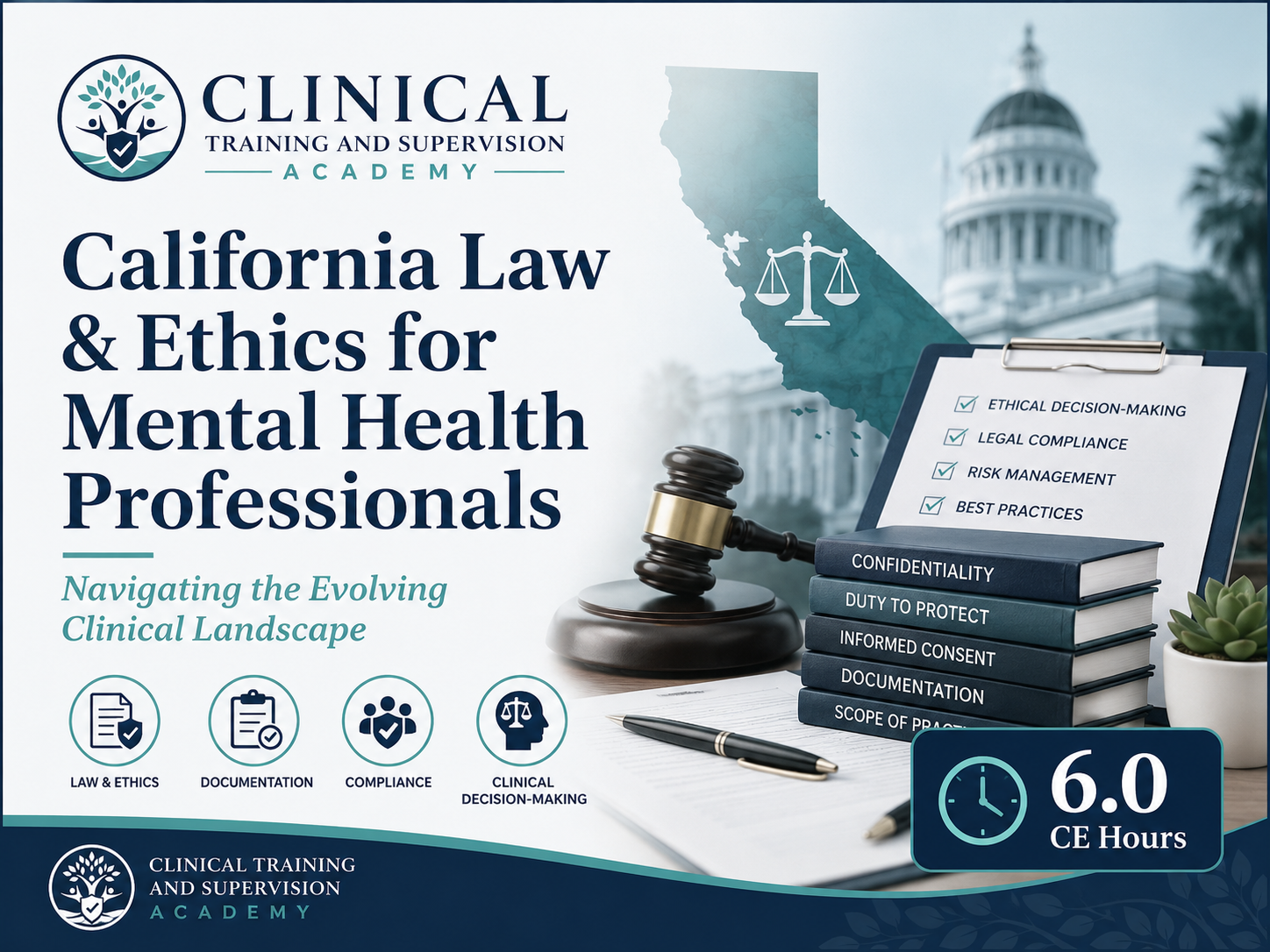
This asynchronous continuing education course provides structured clinical training in California Law & Ethics for Mental Health Professionals: Navigating the Evolving Clinical Landscape. It is designed for LMFTs, LCSWs, LPCCs, LEPs, and Registered Associates and combines online text, instructional video…
Course Description
Course Information
- Course Code: CTA-CE-001
- Course Level: Introductory to Intermediate
- Target Audience: LMFTs, LCSWs, LPCCs, LEPs, and Registered Associates
- Instructional Method: Asynchronous Distance Learning
- CE Credits: 6 CE Hours (360 Minutes of Active Instruction)
- Presenter/Author: Candice Fuimaono, MS, LMFT
Educational Goals
- Strengthen the ability to identify and respond to legal and ethical issues encountered in California mental health practice.
- Enhance knowledge of California laws, regulations, professional standards, and Board of Behavioral Sciences expectations.
- Improve informed-consent, confidentiality, privilege, documentation, record-management, and risk-management practices.
- Increase confidence in making legally and ethically sound decisions involving minors, digital practice, crisis response, and professional boundaries.
- Support client welfare, professional accountability, and continuity of care across private and organizational settings.
What Participants Will Learn
- Identify four California legal, regulatory, or ethical sources that govern mental health practice and distinguish scope of practice from scope of competence.
- Prepare an informed-consent checklist that includes required fee, privacy, telehealth, digital-communication, and professional-boundary elements.
- Distinguish confidentiality, psychotherapist-patient privilege, and lawful disclosure and select an appropriate response to a subpoena or request for records.
- Apply California minor-consent, parental-involvement, custody, and mandated-reporting standards to a clinical case example.
- Apply California duty-to-protect, crisis-intervention, and documentation standards to a case involving suicide risk or a serious threat of violence.
- Prepare a record-management and practice-continuity plan that addresses client access, retention, security, practice closure, professional wills, and licensure or business-risk concerns.
Instructional Modules
Enroll in this course to unlock all modules and the final quiz.
-
1Module 1: California Regulatory Frameworks, BBS Requirements, and Professional Competence60 min
Summary of Main Points
- California regulatory updates and Board of Behavioral Sciences requirements
- Scope of competence and ethical practice standards
- Common disciplinary concerns and risk factors
-
2Module 2: Informed Consent, Telehealth, and Digital Boundaries58 min
Summary of Main Points
- Legal and ethical requirements for informed consent
- Digital practice boundaries and electronic communication
- Fee, privacy, telehealth, and professional-boundary disclosures
-
3Module 3: Confidentiality, Privilege, and Lawful Disclosure62 min
Summary of Main Points
- Confidentiality and psychotherapist-patient privilege
- Mandatory and permissive disclosure exceptions
- Mandated reporting standards and thresholds
-
Mid-Course Knowledge CheckAdmin
Mid-course knowledge check — administrative activity. Not counted toward CE instructional minutes.
-
4Module 4: Working with Minors: Consent, Parents, Custody, and Reporting58 min
Summary of Main Points
- Minor-consent treatment regulations
- Parental rights and involvement considerations
- Confidentiality considerations when treating minors
-
5Module 5: Crisis Management, Tarasoff Duties, and Professional Liability53 min
Summary of Main Points
- Tarasoff duty-to-protect requirements
- Crisis management and emergency-response procedures
- Documentation of risk assessment and protective actions
-
6Module 6: Record Keeping, Business Ethics, and Practice Continuity55 min
Summary of Main Points
- Defensible clinical documentation standards
- Risk-management and licensure protection
- Professional wills and practice closure considerations
-
7Required Course Integration Capstone: Applying California Law and Ethics in Complex Clinical Decisions14 min
Summary of Main Points
- Integrate legal and ethical decision-making across Modules 1–6
- Apply California Law & Ethics standards to complex clinical scenarios
- Prepare for the final examination with structured clinical reasoning
Final Examination
Final examination — 25 questions, 70% to pass, unlimited attempts. Not counted toward CE instructional minutes.
Course-Specific Evaluation
After passing the final examination, complete the course-specific evaluation, including a rating for each measurable learning objective. Evaluation time is not counted toward CE instructional minutes.
Course-Completion Attestation
Submit the required course-completion attestation for asynchronous distance learning before a CE certificate is issued.
Certificate
A CE certificate is issued only after all completion requirements are satisfied (modules, final examination, evaluation, and attestation).
Course Completion Requirements
- Complete all required instructional modules, including the Course Integration Capstone, and embedded learning activities.
- Earn a score of at least 70% on the final examination. Participants may repeat the examination until the passing score is achieved.
- Complete the course-specific evaluation, including a rating for each measurable learning objective.
- Submit the required course-completion attestation for asynchronous distance learning.
- A CE certificate is issued only after all completion requirements are satisfied.
References
- California Association of Marriage and Family Therapists. (2019). CAMFT code of ethics. CAMFT.
- Caldwell, B. E. (2020). User's guide to the 2019 CAMFT code of ethics. Ben Caldwell Labs.
- Zur, O. (2021). Digital ethics and telehealth in psychotherapy: Navigating the boundaries of remote care. Routledge.