
Advanced Suicide Risk Assessment: Evidence-Based Intervention and Ethical Documentation
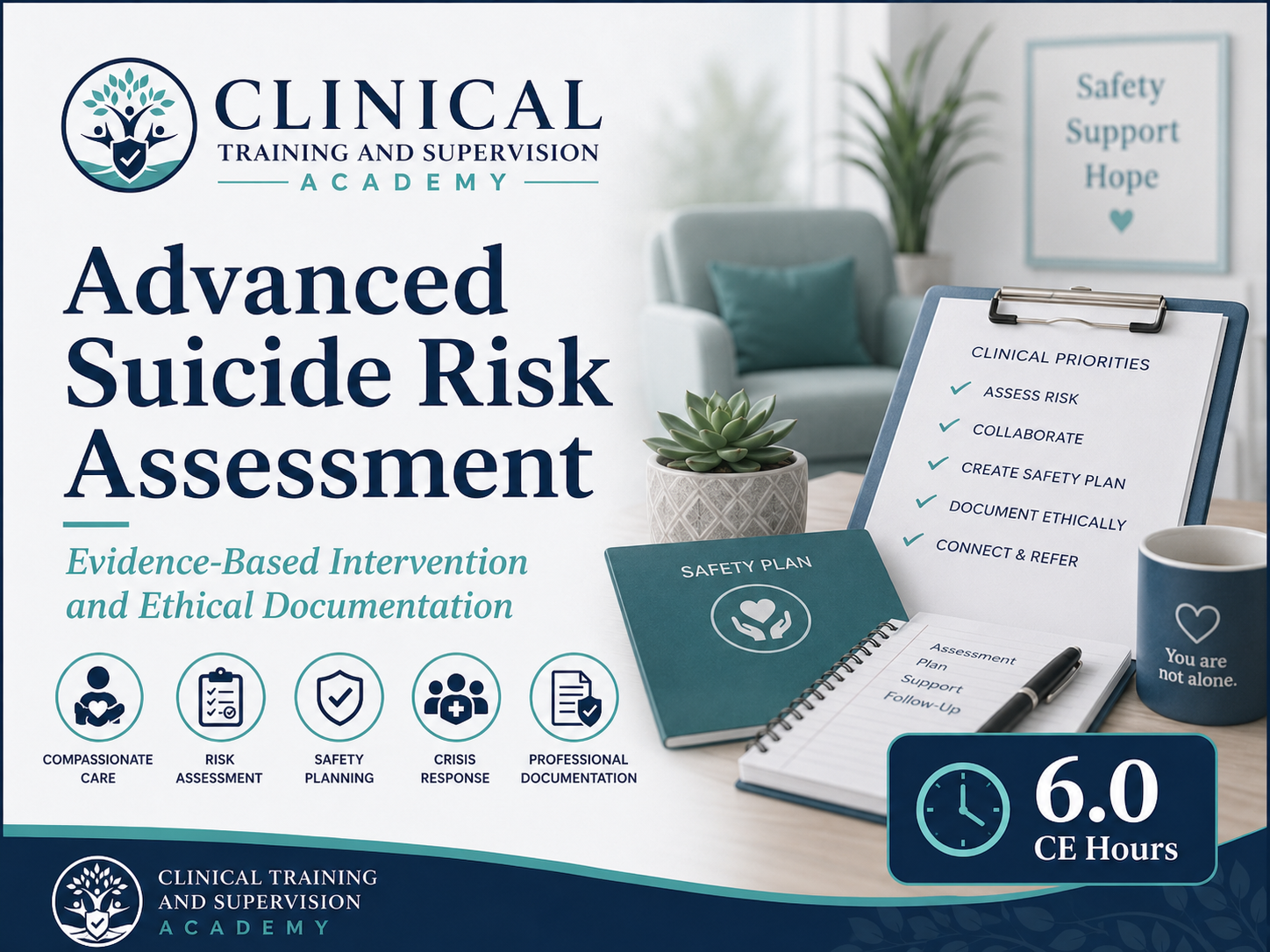
Strengthen clinical judgment in suicide-risk assessment, formulation, safety planning, escalation, documentation, and postvention. This six-hour asynchronous course helps California mental health professionals use structured tools appropriately, develop person-specific formulations, apply collaborative safety-planning and lethal-means-safety principles, navigate level-of-care decisions, and document high-risk care clearly.
Course Description
Course Information
- Course Code: CTA-CE-003
- Course Classification: Core Tier Continuing Education Course
- Course Level: Intermediate to Advanced
- Target Audience: LMFTs, LCSWs, LPCCs, and Registered Associates
- Instructional Method: Asynchronous Distance Learning
- CE Credits: 6 CE Hours (360 Minutes of Active Instruction)
- Presenter/Author: Candice Fuimaono, MS, LMFT
What Participants Will Learn
- Identify at least five warning signs, risk factors, or protective factors associated with suicide risk and distinguish chronic suicidal ideation, acute suicidal intent, and non-suicidal self-injury.
- Apply the Columbia-Suicide Severity Rating Scale and the SAFE-T framework to a clinical case and classify information needed for a comprehensive suicide-risk formulation.
- Prepare a collaborative six-step safety plan that includes warning signs, coping strategies, social supports, professional resources, and lethal-means safety.
- Identify three clinical or legal factors relevant to a California danger-to-self determination and select an appropriate crisis-response or level-of-care action.
- Write a suicide-risk documentation note that includes at least four elements supporting clinical rationale, consultation, intervention, and follow-up.
- Design a postvention and clinician-support protocol that addresses continuity of care, consultation, countertransference, secondary traumatic stress, and professional wellness.
Instructional Modules
Enroll in this course to unlock all modules and the final quiz.
-
1The Epidemiology and Phenomenology of Suicide60 min
Summary of Main Points
- National and regional suicide statistics
- Trends across demographic and clinical groups
- Mental illness, substance use, and suicide risk
- Psychosocial stressors and high-risk transitions
- Chronic suicidal ideation versus acute intent
- Non-suicidal self-injury versus suicidal behavior
- Continuum and context of suicide risk
-
2Standardized Assessment and Comprehensive Risk Formulation60 min
Summary of Main Points
- Importance and limitations of structured tools
- Columbia-Suicide Severity Rating Scale
- SAFE-T framework
- Warning signs, risk factors, and protective factors
- Assessment beyond intuition or a single score
- Risk formulation and clinical decision-making
- Translating findings into treatment and disposition decisions
-
3Moving Beyond No-Harm Contracts to Collaborative Safety Planning60 min
Summary of Main Points
- Limitations of no-harm or no-suicide contracts
- Evidence supporting collaborative safety planning
- Stanley-Brown Safety Planning Intervention
- Personal warning signs and internal coping strategies
- Social supports and environmental distractions
- Professional resources and crisis contacts
- Lethal-means safety and collaborative implementation
-
4Involuntary Evaluation, Hospitalization, and Legal Thresholds60 min
Summary of Main Points
- California Welfare and Institutions Code section 5150
- Danger-to-self considerations
- Clinical indicators supporting emergency evaluation
- When hospitalization may be clinically appropriate
- Coordination with mobile crisis, emergency departments, and law enforcement
- Voluntary alternatives and least-restrictive care
- Legal and ethical considerations involving minors
-
5Clinical Documentation, Consultation, and Liability Management60 min
Summary of Main Points
- Documentation of risk and protective factors
- Recording assessment findings and clinical rationale
- Incorporating standardized tools into progress notes
- Consultation and supervision documentation
- Interventions considered, selected, and declined
- Follow-up, continuity of care, and communication
- Defensible standards of care and risk management
-
6Postvention, Clinician Wellness, and Professional Recovery60 min
Summary of Main Points
- Clinical and emotional impact of suicide-related cases
- Response following attempts or suicide deaths
- Postvention, continuity of care, and communication
- Peer consultation and professional support
- Secondary traumatic stress and compassion fatigue
- Countertransference awareness and management
- Long-term clinician wellness and professional recovery
Final Examination
Final examination — 25 questions, 70% to pass, unlimited attempts. Not counted toward CE instructional minutes.
Course-Specific Evaluation
After passing the final examination, complete the course-specific evaluation, including a rating for each measurable learning objective. Evaluation time is not counted toward CE instructional minutes.
Course-Completion Attestation
Submit the required course-completion attestation for asynchronous distance learning before a CE certificate is issued.
Certificate
A CE certificate is issued only after all completion requirements are satisfied (modules, final examination, evaluation, and attestation).
Course Completion Requirements
- Complete all required instructional modules and embedded learning activities.
- Earn a score of at least 70% on the final examination. Participants may repeat the examination until the passing score is achieved.
- Complete the course-specific evaluation, including a rating for each measurable learning objective.
- Submit the required course-completion attestation for asynchronous distance learning.
- A CE certificate is issued only after all completion requirements are satisfied.
Educational Notice
Educational material only. This course does not provide legal advice, determine whether any individual meets emergency-detention criteria, establish a universal standard of care, or replace clinical supervision, consultation, current law, employer policy, emergency services, or case-specific legal counsel.
References
- Boudreaux, E. D., & Camargo, C. A. (2021). Managing suicidal risk in the modern clinical setting: Tools for screening and stabilization. Oxford University Press.
- Bryan, C. J. (2022). Rethinking suicide: Why prevention fails, and how we can do better. Oxford University Press.
- Stanley, B., & Brown, G. K. (2020). Safety planning intervention: A brief intervention to mitigate suicide risk. Journal of Clinical Psychiatry, 81(2), 11-19.